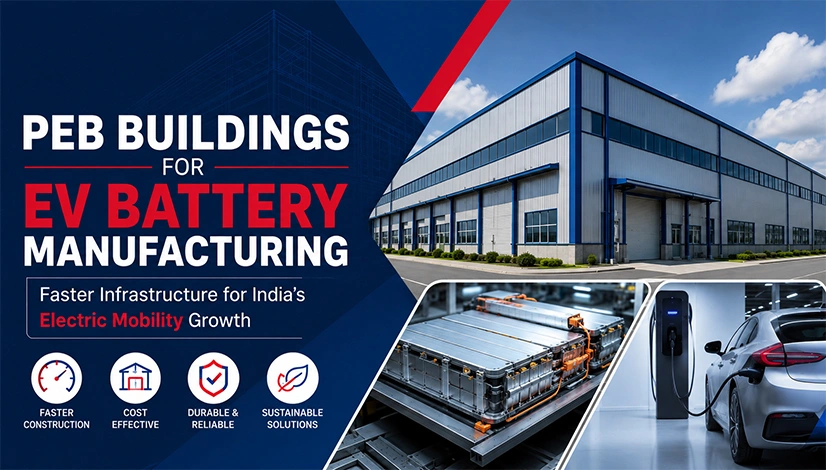

India’s electric mobility growth is no longer limited to vehicle launches and charging stations. Behind every EV brand, battery pack supplier, cell manufacturer and energy-storage company, there is a growing need for safe, scalable and fast industrial infrastructure. PEB Buildings for EV Battery Manufacturing are becoming a practical answer because they help companies build production halls, assembly lines, storage areas, utility zones and future expansion bays faster than conventional construction.
For businesses entering the EV ecosystem, the right building is not just a shed; it is a productivity platform. PEB Buildings for EV Battery Manufacturing support large clear spans, controlled layouts, fire-conscious design, dust management, insulation, ventilation and modular expansion. As India pushes domestic battery cell production and clean-energy supply chains, factory infrastructure must be ready to move at the speed of the market.
Why PEB Buildings for EV Battery Manufacturing Matter in India
The EV battery ecosystem needs speed, but it cannot compromise on structure, safety or operational flow. PEB Buildings for EV Battery Manufacturing are designed with pre-engineered steel components that are fabricated off-site and assembled at the project location. This makes them suitable for fast-moving industrial projects where delays can affect production timelines, investor commitments and supply-chain partnerships.
India’s Advanced Chemistry Cell battery programme targets 50 GWh of domestic ACC capacity, supported by a Rs 18,100 crore outlay. At the same time, power demand is rising due to EV adoption, AI, data centers and energy storage. These shifts are creating demand for modern manufacturing spaces that can be built, expanded and upgraded efficiently.
Unlike generic industrial sheds, PEB Buildings for EV Battery Manufacturing must support clean workflows, heavy equipment, precise internal zoning and safe movement of materials. A battery plant may include raw material storage, electrode preparation, cell assembly, module assembly, battery pack integration, testing labs, BESS storage areas and dispatch zones. A pre-engineered structure gives planners the freedom to map these functions without unnecessary internal columns that interrupt production flow.
What Makes EV Battery Facilities Different from Normal Factories?
EV battery production is sensitive to temperature, dust, humidity, fire risk, chemical handling and quality checks. That is why PEB Buildings for EV Battery Manufacturing need more attention to building envelope design, service integration and future scalability. The structure must allow proper cable trays, HVAC ducts, compressed air lines, exhaust systems, fire detection, sprinklers where applicable, loading docks and controlled access. Even if the core manufacturing process is added by specialist equipment vendors, the building must be strong enough and flexible enough to support these services from day one.
Prefabricated EV Battery Factory Design
A prefabricated EV battery factory design can reduce civil construction uncertainty because major steel members are engineered before site assembly. This helps improve coordination between the building contractor, process equipment supplier, electrical consultant and safety consultant. PEB Buildings for EV Battery Manufacturing also make it easier to plan future extensions when production capacity increases or when a company adds new battery chemistries, pack lines or testing zones.
Key Benefits of PEB Buildings for EV Battery Manufacturing
1. Faster Project Completion
The biggest benefit of PEB Buildings for EV Battery Manufacturing is speed. Since the structure is designed and fabricated in advance, on-site work becomes more predictable. For EV companies, this can mean earlier machine installation, quicker trial runs and faster commercial production.
2. Large Clear-Span Production Areas
Battery manufacturing and assembly lines often need uninterrupted movement of people, raw materials, forklifts, conveyors and finished packs. PEB Buildings for EV Battery Manufacturing can provide large clear spans with fewer internal obstructions, making the shopfloor more efficient.
3. Easy Expansion for Growing Capacity
EV demand can change quickly. A plant that starts with one assembly line may need additional bays, storage space or testing rooms within a few years. PEB Buildings for EV Battery Manufacturing are suitable for phased expansion because the structure can be planned with future bay additions in mind.
4. Better Integration of Insulation and Ventilation
Battery facilities need a comfortable and controlled production environment. Insulated roofing, wall panels, ridge ventilation, exhaust systems and controlled openings can be integrated into PEB Buildings for EV Battery Manufacturing to support operational efficiency.
5. Cost Predictability
Industrial buyers want clarity on timelines, material usage and long-term maintenance. PEB Buildings for EV Battery Manufacturing can help reduce uncertainty because design, fabrication and erection are planned through an engineered system rather than slow, sequential construction.
Design Zones Required in an EV Battery Manufacturing Building
A well-planned facility is divided into production and non-production zones. For PEB Buildings for EV Battery Manufacturing, the layout should consider raw material receiving, controlled storage, production lines, testing laboratories, charging and formation areas, fire-safe storage, admin offices, utility rooms, loading docks and dispatch areas. The structure should also allow proper floor loading, service height and crane or mezzanine possibilities if required.
The quality of a battery factory depends on how smoothly materials move from one stage to another. Poor layout increases handling time, safety risk and production bottlenecks. That is why PEB Buildings for EV Battery Manufacturing should be designed with a clear operational brief before the final engineering starts. This includes machine placement, aisle widths, emergency access, air movement, lighting, service entries and future expansion points. PEB Buildings for EV Battery Manufacturing also allow project teams to keep production, testing, warehousing and utility planning aligned from the early design stage.
Safety and Compliance Considerations for Battery Plants
Safety is one of the most important factors in EV battery infrastructure. Lithium-ion battery systems require careful storage and handling because thermal events can create serious risks. PEB Buildings for EV Battery Manufacturing should be planned with fire detection, emergency exits, compartmentalized storage, ventilation, safe electrical routing and access for emergency response. The exact safety system depends on process design, battery chemistry, local regulations and consultant recommendations
Fire-Safe Industrial PEB Buildings
Fire-safe industrial PEB buildings are not created by steel alone. They require a complete design approach that includes cladding selection, insulation type, fire-rated partitions where required, safe distance between zones, smoke movement planning and regular maintenance access. PEB Buildings for EV Battery Manufacturing must be engineered in coordination with fire and process safety experts so that the building supports the operational risk profile.
PEB vs RCC for EV Battery Manufacturing Infrastructure
Traditional RCC construction can be useful for many building types, but EV manufacturing often needs speed, flexible spans and easy expansion. PEB Buildings for EV Battery Manufacturing are generally better suited for large industrial shells where production layouts may evolve. RCC may involve longer curing periods, more on-site dependency and heavier civil work. PEB construction allows faster enclosure of the building, so services and equipment installation can begin sooner.
Another advantage is adaptability. If a manufacturer wants to add an extra storage bay, packaging area or service corridor, PEB Buildings for EV Battery Manufacturing can be designed for future extensions. This makes them useful for companies that expect changing production volumes or new product lines. PEB Buildings for EV Battery Manufacturing also reduce the need to disturb existing production areas when future bays are planned correctly.
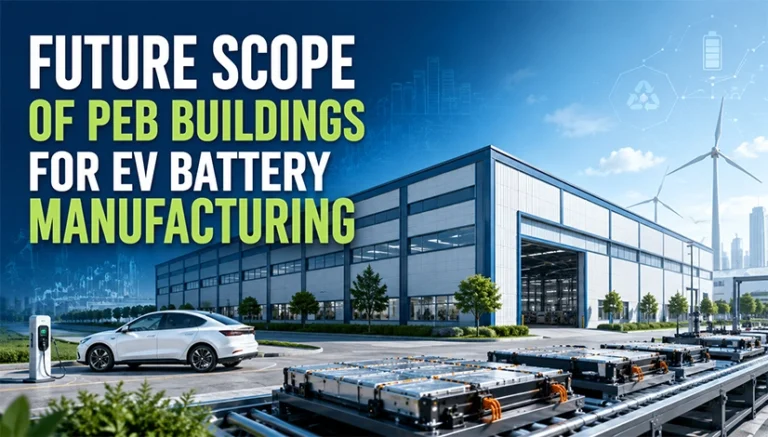
Future Scope of PEB Buildings for EV Battery Manufacturing
India’s battery ecosystem is expanding beyond electric two-wheelers and cars. It now includes buses, commercial vehicles, stationary energy storage, solar integration and grid support systems. Reuters reported that India had about 260 GWh of battery storage projects at different stages of development in July 2026. This wider clean-energy transition increases the need for battery pack plants, assembly facilities and supporting industrial infrastructure.
PEB Buildings for EV Battery Manufacturing can also support ancillary suppliers such as casing manufacturers, thermal management component vendors, wiring harness suppliers, BMS assembly units and packaging companies. As EV supply chains localize, industrial clusters will need fast, scalable buildings that can be delivered with quality and consistency. PEB Buildings for EV Battery Manufacturing give these supplier ecosystems a repeatable infrastructure model across multiple locations.
Why Choose Multi Decor India for Industrial PEB Projects?
Multi Decor India Pvt. Ltd. has decades of experience in prefabricated and pre-engineered building solutions for industrial and commercial applications. For companies planning PEB Buildings for EV Battery Manufacturing, an experienced PEB partner can help convert technical requirements into a practical building system. From large-span structures to industrial sheds, factories, warehouses and project-specific designs, the right execution partner can reduce coordination challenges and improve build quality.
Businesses planning battery plants, EV component factories or clean-energy manufacturing facilities can explore Multi Decor India’s pre-engineered building solutions and industrial infrastructure capabilities. For project-specific discussion, the contact page can be used to request expert guidance for planning, design and execution. With expert planning, PEB Buildings for EV Battery Manufacturing can be customized for fast commissioning and long-term scalability.
Conclusion
The EV industry is moving fast, and infrastructure must keep pace. PEB Buildings for EV Battery Manufacturing offer the speed, scalability and layout flexibility needed for modern battery production and assembly. They help companies plan large production areas, safer storage zones, efficient movement paths and future-ready expansions. As India strengthens domestic battery and clean-energy manufacturing, PEB Buildings for EV Battery Manufacturing can become a preferred choice for companies that want reliable industrial infrastructure without long construction delays. For growth-focused EV companies, PEB Buildings for EV Battery Manufacturing can turn infrastructure planning into a competitive advantage.
FAQs
PEB Buildings for EV Battery Manufacturing are pre-engineered steel structures designed for battery production, assembly, storage, testing and dispatch facilities. PEB Buildings for EV Battery Manufacturing offer faster construction, flexible layouts and easy expansion.
They are suitable because EV battery facilities need large clear spans, controlled internal planning, service integration, ventilation, fire-conscious zoning and future expansion capability.
Yes. PEB Buildings for EV Battery Manufacturing can be planned for battery pack assembly lines, testing areas, material flow, utilities, storage zones and loading docks based on project requirements.
PEB buildings can support safe battery facility design when planned with proper fire systems, ventilation, compartmentalization, emergency exits and process safety recommendations.
Multi Decor India can support PEB Buildings for EV Battery Manufacturing with industrial PEB planning, design and execution for factories, warehouses, production sheds and scalable industrial infrastructure projects.