
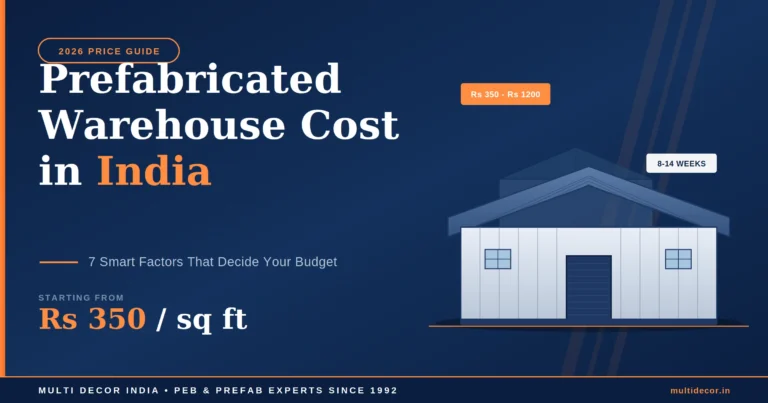
India’s warehousing sector is expanding faster than ever, driven by e-commerce, third-party logistics, cold chain, and ‘Make in India’ manufacturing. For business owners and project managers, understanding the prefabricated warehouse cost in India has become the single most important step before signing any construction contract. Unlike traditional brick-and-mortar storage units, prefab warehouses are engineered off-site, transported, and assembled in weeks — saving you both time and money.
This guide breaks down every realistic cost component, the latest 2026 price ranges, and the smart factors that quietly inflate or reduce the prefabricated warehouse cost in India. Whether you are planning a 5,000 sq ft godown or a 1-lakh sq ft logistics hub, this is the only price guide you need this year.
Table of Contents
What is a Prefabricated Warehouse?
A prefabricated warehouse is a steel-framed storage structure where the columns, rafters, purlins, wall panels, and roof sheets are manufactured in a controlled factory and then assembled at your site. Built using pre-engineered building (PEB) technology, these warehouses use high-tensile steel and insulated sandwich panels for superior strength, faster delivery, and lower lifetime maintenance.
Most modern Indian businesses now prefer this method because the prefabricated warehouse cost in India works out 20% to 35% lower than conventional RCC construction, while installation timelines drop from 9–12 months to just 8–14 weeks.
Average Prefabricated Warehouse Cost in India in 2026
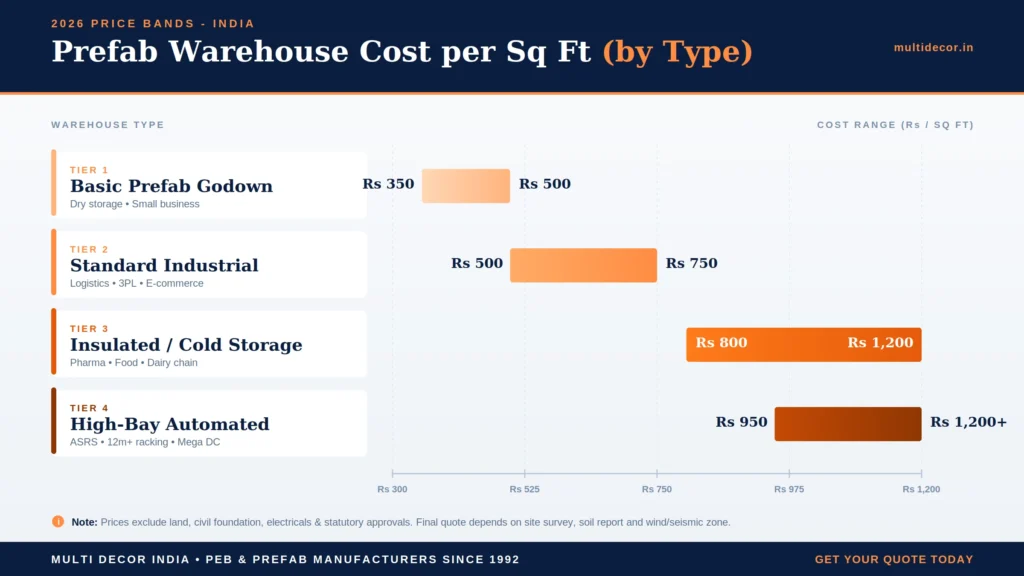
On a pan-India basis, the prefabricated warehouse cost in India for 2026 ranges from Rs 350 to Rs 1,200 per square foot depending on specifications, height, span, and finishes. The table below gives realistic 2026 price bands sourced from active industry quotations.
Note: Prices exclude land, civil foundation, electricals, and statutory approvals. The final prefabricated warehouse cost in India is always quoted after a site visit and load assessment.
7 Factors That Decide the Prefabricated Warehouse Cost in India
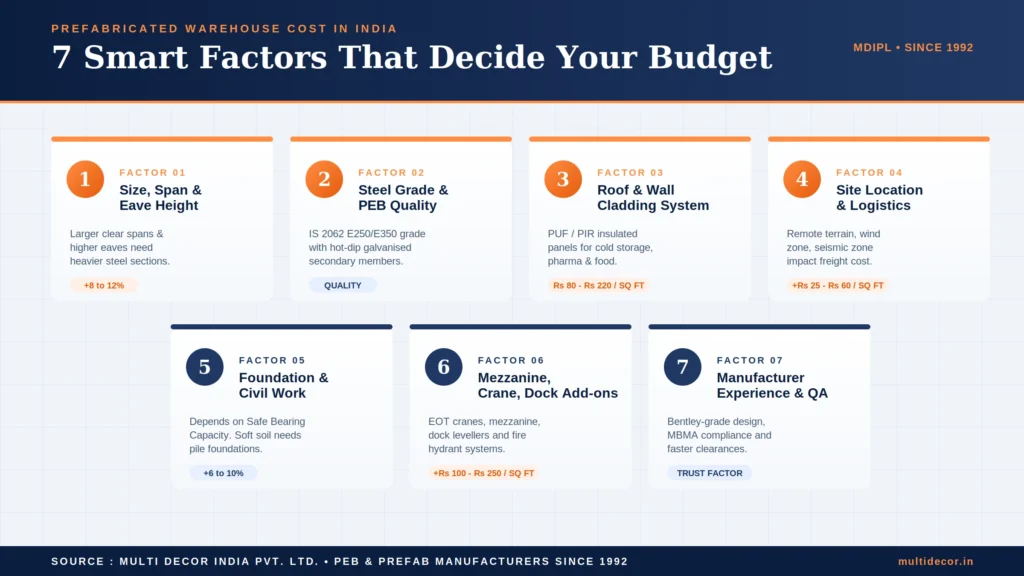
Two warehouses of the same size can have a 40% price difference. Here are the seven factors that genuinely move the prefabricated warehouse cost in India up or down.
1. Size, Span and Eave Height — Largest Lever on Prefab Warehouse Cost in India
Larger clear spans (more than 30 m) and higher eaves (above 9 m) need heavier sections, which raises steel tonnage. A 10 m eave height design can lift the prefabricated warehouse cost in India by 8–12% compared to a standard 6 m eave.
2. Steel Grade and Quality of PEB Components
Reputable manufacturers use IS 2062 E250/E350 grade steel along with hot-dip galvanised secondary members. Using lower-grade steel may reduce upfront cost by 5–7% but slashes structural life by years — and Indian Standards Bureau norms must always be followed.
3. Roof and Wall Cladding System
Single-skin galvalume sheets are the cheapest. PUF/PIR-insulated sandwich panels add Rs 80–Rs 220 per sq ft but are mandatory for cold storage, pharma, and food warehouses. This is the second biggest driver of the prefabricated warehouse cost in India.
4. Site Location and Logistics
Transporting prefab components to North-East India, hilly terrain, or remote SEZs raises freight by Rs 25–Rs 60 per sq ft. Wind-zone classification (Zone IV/V) and seismic zone also impact column sizing.
5. Foundation and Civil Work
Although PEB structures are lighter than RCC, the foundation still depends on Safe Bearing Capacity (SBC) of the soil. Soft soils need pile foundations, adding 6–10% to overall cost.
6. Add-Ons: Mezzanine, Cranes, Dock Levellers
EOT cranes, mezzanine floors, dock levellers, fire hydrants, and rainwater harvesting are not included in basic quotes. These value-additions can lift the prefabricated warehouse cost in India by Rs 100–Rs 250 per sq ft.
7. Manufacturer Experience and Quality Assurance
Choosing experienced prefabricated building manufacturers in India ensures Bentley-grade design, MBMA compliance, and faster regulatory clearance. Cheap, unproven fabricators may cut the prefabricated warehouse cost in India by 10% but pose long-term risks.
Prefab vs Conventional RCC: Real Cost Comparison
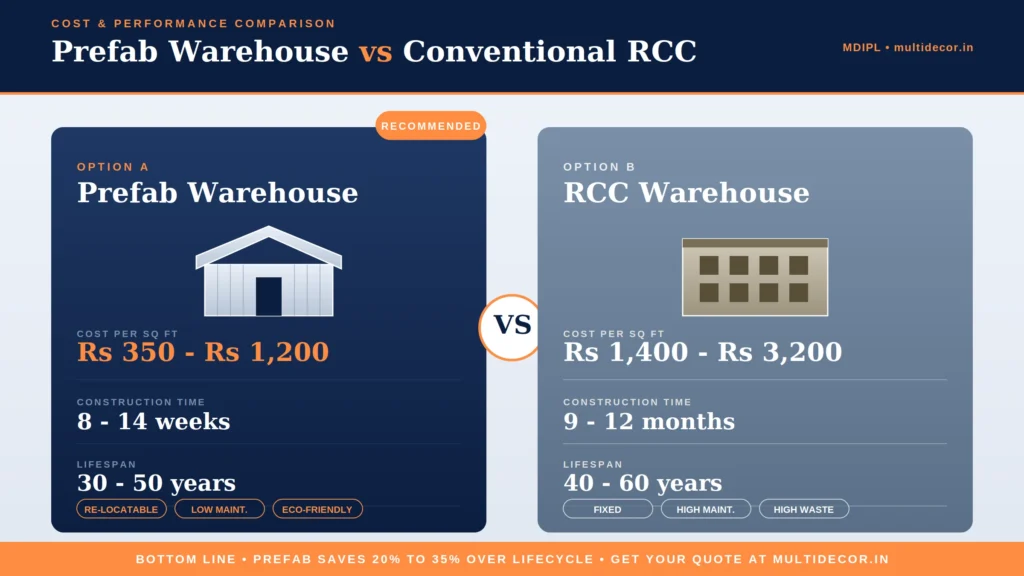
Many buyers still wonder whether traditional concrete construction works out cheaper. The truth — when measured across the project lifecycle — is the opposite. The table below compares the realistic prefabricated warehouse cost in India versus an RCC equivalent.
Parameter | Prefab Warehouse | RCC Warehouse |
|---|---|---|
Cost per sq ft | Rs 350 – Rs 1,200 | Rs 1,400 – Rs 3,200 |
Construction Time | 8 – 14 weeks | 9 – 12 months |
Lifespan | 30 – 50 years | 40 – 60 years |
Re-locatable | Yes | No |
Maintenance Cost / Year | Very Low | Medium to High |
According to publicly available market data, India’s pre-engineered building segment is projected to grow at 10–11% CAGR up to FY29, which is steadily compressing the prefabricated warehouse cost in India due to higher domestic steel capacity and automation.
Hidden Charges Most Buyers Forget to Budget
- GST at 18% on the total contract value
- Site survey, soil testing, and topographical surveys
- Statutory approvals — fire NOC, factory licence, panchayat permissions
- Crane mobilisation and on-site erection insurance
- Anti-corrosive paint and periodic touch-ups for coastal sites
How to Reduce Your Prefabricated Warehouse Cost in India
Smart procurement can bring down the prefabricated warehouse cost in India by 8–15% without compromising on safety. Use the checklist below before placing the order.
- Lock in steel rates with a fixed-price contract for 60–90 days
- Use modular bay spacing (8 m or 9 m) to optimise steel tonnage
- Choose galvalume sheets over imported cladding for non-insulated zones
- Plan future expansion in the original design to avoid retrofit costs
- Ask for a turnkey scope to remove agency margins between vendors
Why Choose MDIPL for Your Prefab Warehouse Project
Established in 1992 and recognised in Bentley’s Year in Infrastructure 2020 Book, Multi Decor India Pvt. Ltd. has delivered industrial projects from Jewar Airport to Tata Cancer Centre. The team designs every structure for the exact wind, seismic, and snow load of the site — giving you a transparent, lifecycle-optimised prefabricated warehouse cost in India.
Explore our dedicated solution for prefabricated warehouse manufacturing or talk to our engineering team via the Contact Us page for a customised site-specific quote.
Frequently Asked Questions on Prefabricated Warehouse Cost in India
For a basic 5,000 sq ft galvalume-sheet godown, the entry-level prefabricated warehouse cost in India starts at around Rs 350 per sq ft, excluding land and civil work.
Yes. According to industry data published by
the Wikipedia article on Prefabrication, prefab structures typically cost 20–35% less than equivalent on-site RCC construction across their lifecycle.
With proper paint cycles and routine inspection, the structure has a design life of 30 to 50 years — making the prefabricated warehouse cost in India highly cost-efficient on a per-year basis.
You can review independent market reports from The Economic Times Warehousing & Logistics section to understand current absorption rates and demand forecasts.
Final Word on Prefabricated Warehouse Cost in India
Prefab construction is no longer the ‘alternative’ option — it is the new mainstream. With steel manufacturing capacity rising and automated PEB factories scaling up across Faridabad, Pune, and Hyderabad, the prefabricated warehouse cost in India is becoming more predictable and more attractive every quarter. Choose an experienced, certified manufacturer, demand a detailed BOQ, and never compromise on steel grade — that is the formula for a warehouse that pays for itself within the first three years.
For more practical guides, do read our PEB Warehouse Construction Timeline & Benefits Guide on the MDIPL blog.